


Jawaban singkat
Standard PPR is sufficient when a piping system does not require the added benefits of aluminum reinforcement. Aluminum composite PPR is useful when lower thermal expansion, greater dimensional stability, or an oxygen barrier matters to the project. DESO offers both standard PPR and PPR aluminum composite pipe for different piping requirements.

When Is Standard PPR Sufficient Without Composite Pipe?
When aluminum reinforcement won’t solve a specific design issue, standard PPR tends to be sufficient.
Many concealed residential piping runs fall into this category. Standard PPR can also handle hot water when you match the pipe series to the operating conditions. This means hot water alone should not be the reason for switching to a composite pipe.
At DESO, our ስታንዳርድ ፒፒአር ቧቧ comes in sizes from 20 to 160 mm and PN10, PN12.5, PN16, and PN20.
Standard PPR vs. Composite PPR: What Are the 3 Key Differences?
The three main differences in a PPR pipe vs aluminum composite pipe comparison are thermal expansion, dimensional stability, and oxygen protection.
Thermal expansion: Standard PPR expands and contracts as its temperature changes. The aluminum layer restricts this movement. Published technical data for comparable products puts standard PPR around 0.15 mm/m·K and aluminum-reinforced PPR around 0.03–0.04 mm/m·K.
Dimensional stability: Less expansion means less movement along the pipe run. This can help an aluminum composite pipe maintain its alignment along long, visible installations.
Oxygen barrier: The continuous aluminum layer acts as a barrier to oxygen diffusion. This can be important in closed-loop heating systems containing ferrous components such as radiators, pumps, and boiler heat exchangers.
These differences do not mean composite PPR automatically has a higher continuous temperature or pressure rating. Those limits still depend on the specific pipe construction and operating conditions.
| Isici Sokukhetha | PPR-ya Standard | Aluminum Composite PPR |
| Hot & cold water | Suitable when properly rated | Suitable when properly rated |
| Ukunwetshwa kokushisa | Bilindtir | Kêmkirin |
| Aramiya pîvanî | Rêzan | Better for long/exposed runs |
| Oxygen barrier | No aluminum oxygen-barrier layer | Aluminum layer limits oxygen diffusion |
| Closed-loop heating | Depends on system requirements | More useful where oxygen control matters |
| Lêkirinî | Rêzan hevgirtina germê | May require additional preparation depending on construction |
| Best reason to choose | Aluminum reinforcement adds no necessary benefit | Expansion control or oxygen barrier is required |
Choose aluminum composite PPR because the aluminum layer solves a specific project requirement—not simply because the system carries የሙቅ ውሃ.
When Should You Use Standard PPR?
Standard PPR makes sense for conventional installations where the project does not specifically benefit from aluminum reinforcement.
Concealed residential piping is one example. It can also be a practical choice when a project requires a broader range of diameters or pressure classes. DESO Standard PPR covers 20–160 mm and PN10–PN20, compared with 20–63 mm and PN16–PN20 for our aluminum composite range.
Buyers get more pressure-class and size options when the added expansion control and oxygen barrier of composite PPR are not needed.
When Should You Use PPR Aluminum Composite Pipe?
Composite PPR works best when you need to control pipe movement or when limiting oxygen diffusion is important.
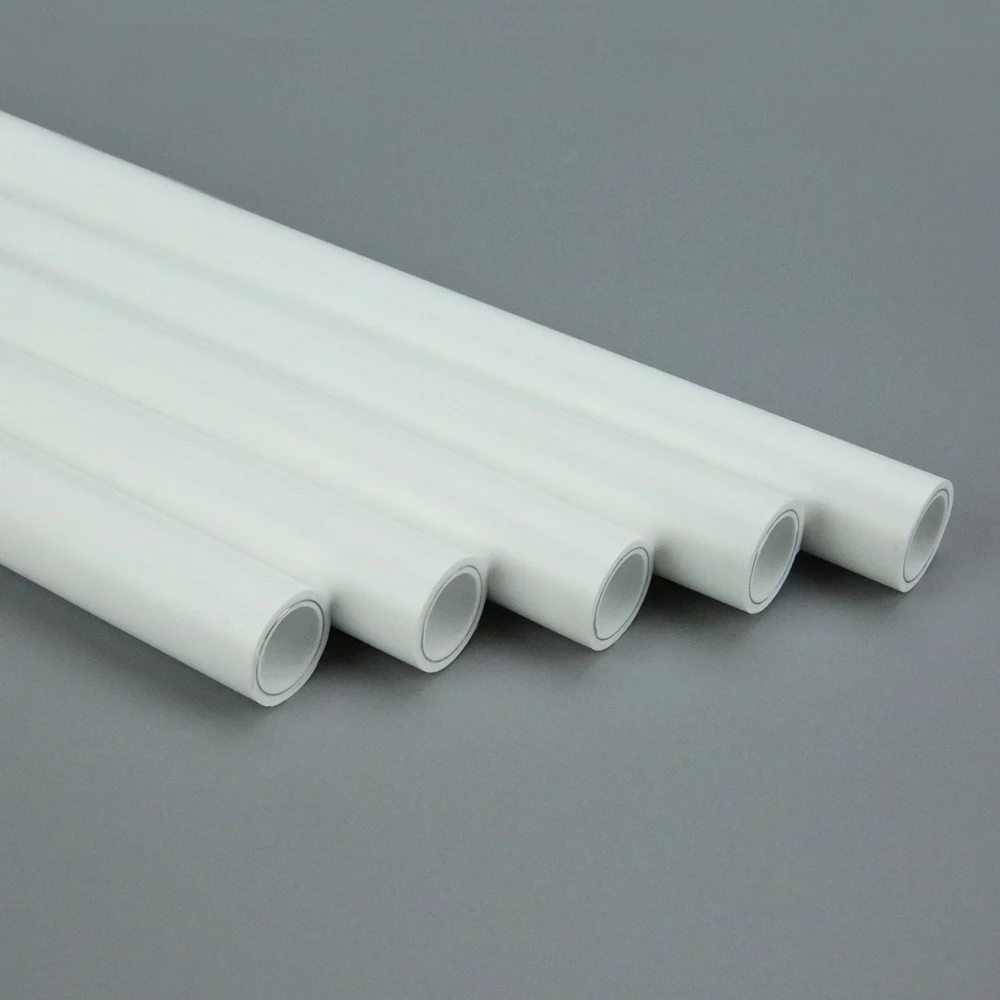
One example of this is long, exposed indoor runs. A PPR pipe with aluminum reinforcement has lower thermal expansion, which helps maintain alignment as temperatures change. DESO’s PPR aluminum composite pipe combines PPR with an aluminum reinforcement layer and is available in PN16 and PN20.
Another useful application involves closed-loop circulation and heating systems. The aluminum layer limits oxygen diffusion into the circulating water, which helps safeguard oxygen-sensitive metal components.
We discuss these characteristics further in our guide to PPR aluminum composite pipes, including how aluminum reinforcement changes the pipe’s behavior.
When Is the Extra Investment in Composite PPR Worth It?
It’s worth it when the project can make practical use of lower thermal expansion or an oxygen barrier.
On long visible runs, reduced expansion can mean less movement to accommodate while keeping the piping aligned. In closed-loop heating systems, the aluminum layer provides the added benefit of limiting oxygen diffusion.
The installation side, however, has a trade-off worth mentioning. Additional preparation is required for some aluminum composite constructions before heat fusion. Make sure to weigh these added benefits against the installation and material requirements when deciding what makes sense for your specific project.
How Can Buyers Choose Between Standard and Composite PPR?
Ask these five questions before deciding:
- Will long, exposed indoor runs make pipe movement or alignment a concern?
- Is the piping part of a closed-loop heating or circulation system?
- Does the system contain ferrous components that need protection from oxygen diffusion?
- Does the composite range cover the required diameter and pressure class?
- Is the installer equipped for the required composite-pipe preparation and fusion procedure?
If the aluminum layer does not provide a clear benefit in these areas, standard PPR may be the more straightforward choice.
Pirsên Pir tên Pirsîn
1. What is the difference between PPR and PPR-AL-PPR pipe?
Standard PPR uses a polymer pipe wall, while PPR-AL-PPR adds aluminum reinforcement. The aluminum reduces thermal expansion, improves dimensional stability, and provides an oxygen barrier.
2. Can PPR aluminum pipe be used for hot water?
Yes. DESO PPR Aluminum Composite Pipe is designed for hot and cold water systems. The aluminum reinforcement helps control temperature-related pipe movement.
3. Is PPR-AL-PPR pipe worth the extra cost?
It can be when the project benefits from lower thermal expansion, greater dimensional stability, or an oxygen barrier. If those properties are unnecessary, standard PPR may already meet the requirements.
4. Which is better, PPR pipe or aluminum composite pipe?
It depends on the system. Standard PPR suits applications that do not need aluminum reinforcement, while composite PPR provides lower thermal expansion, greater dimensional stability, and an oxygen barrier.
5. Does PPR aluminum pipe reduce thermal expansion?
Yes. The aluminum layer restricts temperature-related movement, giving PPR-AL-PPR substantially lower linear thermal expansion than standard PPR.


