


Réponse rapide
Standard PPR is well suited to potable water supply, hot and cold water distribution, and internal piping networks in residential and commercial buildings. Its corrosion resistance and heat-fused connections make it a practical choice for long-term water distribution. DESO Standard PPR Pipe is available in multiple sizes and pressure classes for building water-supply applications.
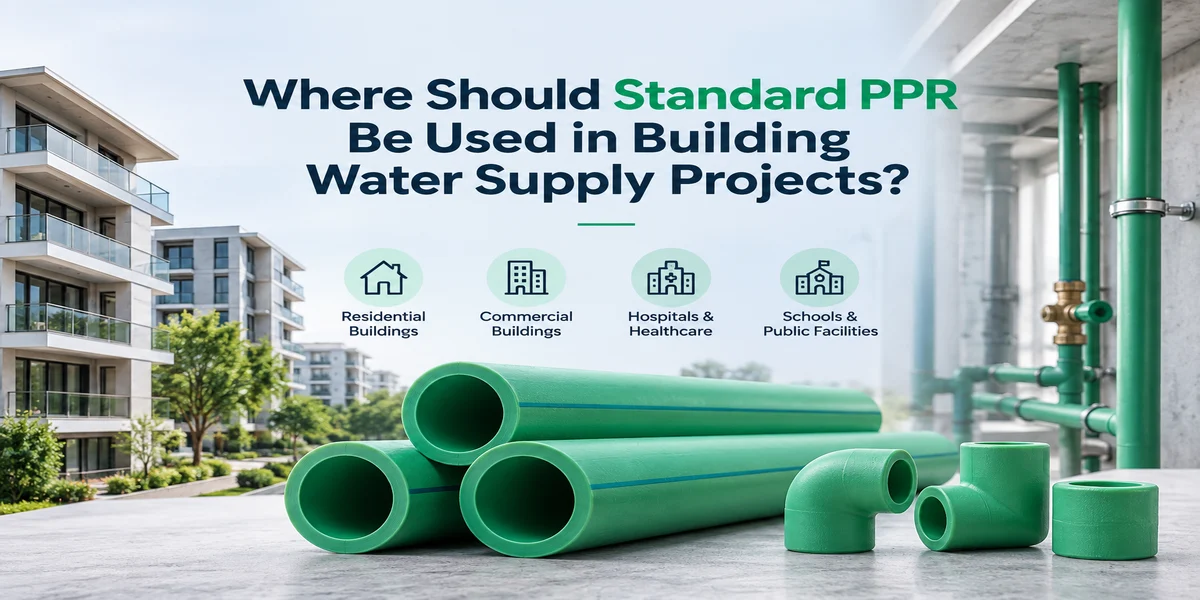
What Are the Main Applications of Standard PPR in Water Supply Projects?
A PPR pipe for water supply can serve both hot and cold lines when the correct pipe series is selected for the system’s temperature and pressure. A PPR water supply pipe can distribute water throughout a building.
PPR pipe plumbing is suitable for homes, hotels, hospitals, offices, and schools. At DESO, our Standard PPR pipe is available for hot and cold potable-water networks in these types of buildings.
Why Choose PPR Instead of PVC or PEX for Water Supply?
Buildings requiring a rigid, heat-fused piping system for both cold and hot water can be a good fit for PPR.
If we do a PPR pipe vs. PVC comparison, standard PVC-U is typically meant for cold-water applications. PPR, meanwhile, can be specified as PPR pipe for cold water or PPR pipe for hot water supply, depending on the pipe series and operating conditions. CPVC is different from PVC-U and can also be used for hot water.
In a PPR pipe vs. PEX comparison, installation is the main difference. Being flexible makes PEX easier to route around obstacles. PPR uses heat-fused fittings and is a lot more rigid than PEX. The type you choose depends on the operating conditions and layout, along with the method you’ll use for installation.
When Should You Not Use Standard PPR Pipe?
You should not use standard PPR for steam or continuous service outside its rated pressure and temperature conditions. Neither should it be subject to prolonged UV exposure without protection. If you need PPR pipe specifically designed for outdoor UV exposure, DESO’s PPR Anti-UV pipe might be worth a look.
Keep in mind that tall buildings are not automatically unsuitable for PPR. The systems in these buildings should account for pressure zoning, pipe series, temperature, water hammer, and static pressure. If those demands exceed standard PPR’s design limits, you may need to consider another piping system for your project.
How Do You Choose the Right PN Rating, Diameter, and Temperature?
Choose the pipe series based on the system’s operating temperature and design pressure, then size the diameter for the required flow and acceptable pressure loss.
Our Standard PPR Pipe is available in four series:
- PN10: SDR11/S5
- PN12.5: SDR9/S4
- PN16: SDR7.4/S3.2
- PN20: SDR6/S2.5
Within these DESO Standard PPR series, higher PN classes use thicker pipe walls at the same outside diameter. However, PN is not the allowable working pressure at every temperature. For hot-water service, check the manufacturer’s pressure-temperature data for the intended operating conditions. This helps avoid overloading the selected pipe series.
Size the diameter to provide the required flow while keeping velocity and pressure loss within design requirements.
How Long Does Standard PPR Last in Water Supply Projects?
Service life depends on operating temperature, pressure, installation quality, and environmental exposure. Our technical data states that DESO PP-R systems can provide more than 50 years of service at constant temperatures up to 70°C, depending on pressure.
What Should Buyers Check Before Ordering Standard PPR Pipe?
| Check | What to Confirm |
| Application | Cold water, hot water, or both |
| Température de fonctionnement | Normal and maximum water temperature |
| Design pressure | Actual system pressure and pressure zone |
| PN / SDR | Match to temperature and pressure—not PN alone |
| Pipe diameter | Required flow and acceptable pressure loss |
| Environnement d'installation | Indoor, concealed, exposed, or outdoor |
| Standards / approvals | Project and destination-market requirements |
| Order quantity | Diameter × PN class × required pipe length |
DESO Standard PPR Pipe is available in 20–160 mm sizes across PN10, PN12.5, PN16 and PN20 series, allowing buyers to match different pressure and piping requirements within one product family.
FAQ
1. Is PPR pipe better than PVC?
PPR is generally more suitable when a building needs both hot and cold water distribution. PVC-U is commonly used for cold-water service, so the better material depends on the application.
2. Which is better, PEX or PPR?
PEX is flexible and easier to route through complex layouts, while PPR provides a rigid system with heat-fused connections. The better choice depends on the project layout and installation requirements.
3. What are the disadvantages of PPR pipes?
Standard PPR requires fusion equipment and proper installation, expands with temperature changes, loses pressure capacity at higher temperatures, and needs protection from prolonged UV exposure.
4. What is the average lifespan of PPR pipes?
PPR systems can provide 50 years or more of service under suitable operating conditions, but actual lifespan depends on temperature, pressure, installation, and environmental exposure.
5. What is the best pipe for a residential water line?
PPR is one option for residential hot and cold water lines, alongside materials such as PEX and copper. The best choice depends on local codes, water conditions, pressure, temperature, and building layout.
6. What plumbing pipes last the longest?
PPR, PEX, copper, and other approved plumbing materials can all provide decades of service when correctly selected, installed, and operated within their rated conditions.


