


Standard PPR pipe carries water continuously at temperatures up to about 70°C, with short peaks near 95°C. Its melting and softening behavior sits far higher, around 130°C, so the pipe never operates anywhere near that point.
That gap matters. Many buyers confuse the working temperature with the melting point and pick the wrong pipe grade. In this guide, you will learn the difference, how the temperature range of PPR pipe grades affects pressure and lifespan, which pipe suits each application, and how PPR pipes are correctly joined.
Why Do Temperature Ratings Matter?
Temperature ratings define how a pipe behaves under real heat and pressure. Ignore them, and you risk leaks, sagging, or early failure. Get them right, and the system lasts decades.
Pressure
Pressure capacity drops as temperature rises. A pipe rated for 20 bar at 20°C holds far less at 70°C. Ratings guide safe pressure selection.
Lifespan
PPR follows a creep-based aging curve. Lower temperatures mean slower stress damage. Proper design supports a service life of 50 years or more.
Safety
Overheated pipe softens and deforms. Correct ratings keep joints intact and prevent sudden bursts in occupied buildings.
What Is The Working Temperature Of PPR Pipe?
Working temperature is the heat a pipe handles continuously without losing strength over its design life. For standard PPR, this is commonly up to 70°C, depending on pressure and SDR.
The temperature range of the pipe standard grades covers runs roughly from -10°C to 70°C in continuous use. Short-term peaks near 95°C are tolerated for limited periods. This balance gives PPR pipes high temperature resistance suited to hot water service.
The practical PPR pipe maximum temperature for continuous duty is therefore about 70°C, not the higher peak figures. Designing for the continuous value protects long-term performance.
What Is The Melting Point Of PPR?
PPR does not have a single sharp melting point like a metal. Instead, it softens gradually as the heat increases. Engineers use the Vicat softening temperature as a reference, which sits around 130°C for quality raw material.
At this point, the polymer becomes soft enough to deform under load. Short disruptions reaching 100°C can be tolerated without damage. Still, sustained operation near softening would shorten life dramatically.
What Is The Difference Between Working Temperature And Melting Point?
Working temperature is a safe, continuous operating limit. The softening or melting region is the physical point where the material loses rigidity. They are not the same, and the gap is intentional.
The table below summarizes the key thresholds for standard PPR.
| Parameter | Typical Value | Notes |
| Continuous working temperature | Up to ~70°C | Depends on pressure and SDR |
| Short-term peak | ~95°C | Limited duration only |
| Brief disruption tolerance | ~100°C | Short, occasional spikes |
| Vicat softening temperature | ~130°C | Material begins to deform |
| Socket fusion tool temperature | 260°C ±5°C | For joining, not operation |
Notice the fusion temperature is far above operating limits. Heat fusion melts the surface briefly to bond the pipe and fitting, then the joint cools solid.
How Does Temperature Affect Pressure Ratings?
Higher temperature lowers allowable pressure. This is called derating. The polymer creeps more under heat, so the safe stress falls.
For example, a PN20 pipe holding 30 bar at 20°C may carry only about 13 bar at 70°C. Designers apply derating factors based on temperature, SDR, and service life. A safety factor of 1.25 to 1.5 is standard under ISO 15874.
This is why a temperature control ppr pipe selection always pairs the operating temperature with the working pressure before choosing a grade.
Which Applications Match Each Temperature Range?
Matching the pipe to the duty avoids both over-spending and early failure.
Cold Water
Cold potable and chilled lines run near 20°C. Standard PPR or a thinner SDR grade works well here. A chemical-resistant PPR pipe for water also resists scaling and corrosion in these systems.
Hot Water
Domestic hot water risers run around 55°C to 60°C. A higher PN grade handles the heat and pressure. Many hotels and hospitals rely on this for daily supplies.
Heating Systems
HVAC heating loops and radiator connections see sustained heat near 70°C with peaks above. These need a high-temperature-resistant PPR pipe, often fiber composite or PP-RCT, to control expansion.
Why Does Fiber Composite PPR Perform Better In High-Temperature Systems?
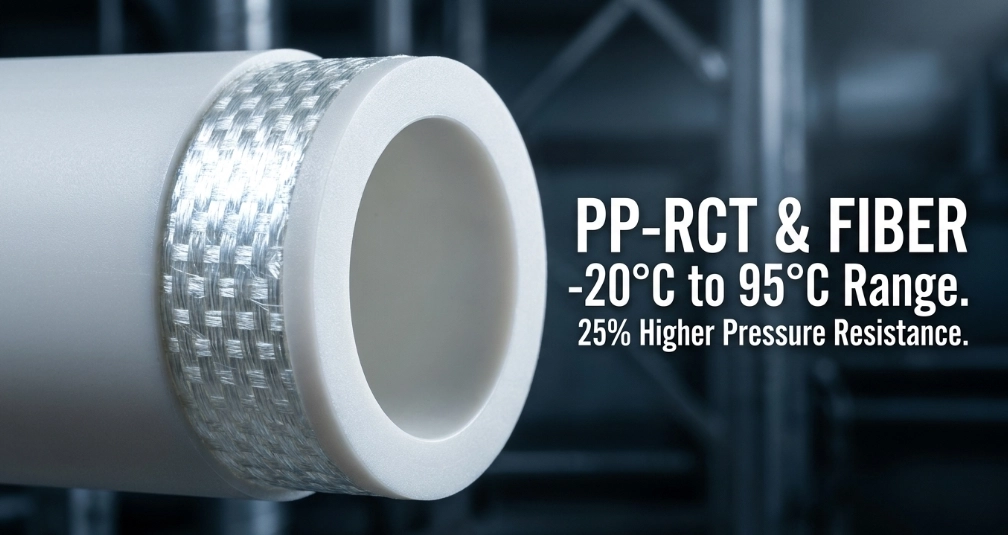
Standard PPR expands noticeably when hot. Fiber-reinforced PPR adds a glass fiber middle layer that cuts thermal expansion sharply. This reduces sagging and stress on long runs.
PP-RCT raises the bar further. It offers about 25% higher pressure resistance and long-term strength than previous PP-R, with a temperature range of -20°C to 95°C. Better creep resistance comes from high-grade polymer raw materials engineered for sustained heat.
For high-rise risers and industrial water lines, this means tighter spacing and steadier pressure. Designing a Commercial PPR Pipe System: The Ultimate Engineering Guide explains how to manage this thermal movement.
Can PPR Pipes Be Glued?
No. PPR pipes are not joined with solvent glue. They are bonded by heat fusion, which melts and fuses the material into one piece.
This is a common point of confusion for installers moving from PVC. Understanding why protects your system.
Why Do Traditional PVC Adhesives Not Work On PPR Pipes?
Solvent cement works on PVC because the solvent dissolves the surface and welds it chemically. Polypropylene resists those solvents, so the chemistry never bonds.
The same chemical resistance that makes a chemical-resistant PPR pipe for water so durable also blocks adhesive joining. Glue may appear to stick, but it offers no real strength under pressure.
How Are PPR Pipes Actually Joined?
PPR relies on thermal joining methods that create a homogeneous bond. Three methods cover most projects.
Socket Fusion
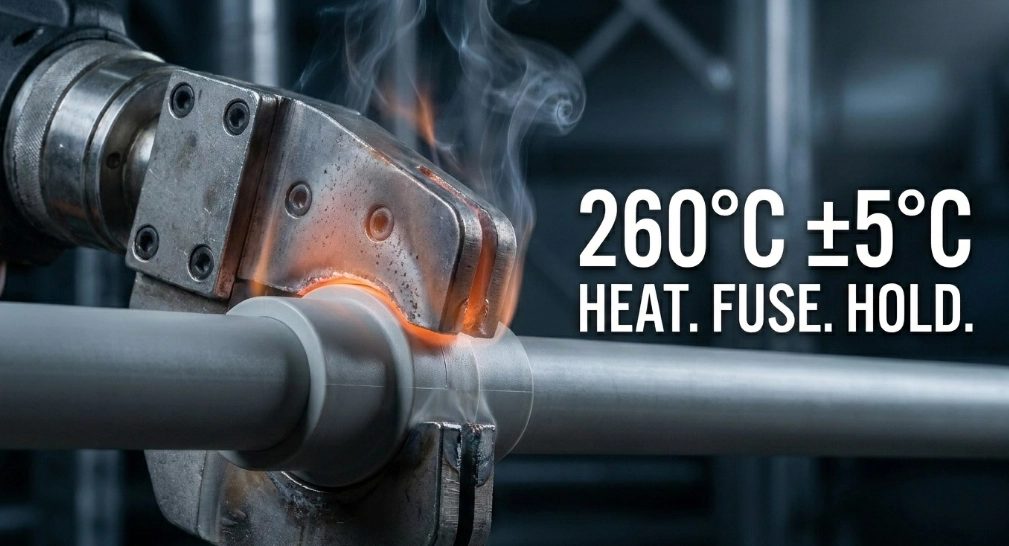
A heating tool warms the pipe end and fitting socket at 260°C ±5°C. The parts are pushed together and held briefly. Heating times scale with size: about 5 seconds for 20 mm, 7 seconds for 25 mm, and 8 seconds for 32 mm.

Threaded Fittings
Brass-insert threaded fittings connect PPR to metal pipes, valves, or fixtures. They allow safe transitions without fusion.
Flanged Connections
Flanges suit large diameters and equipment connections. They allow disassembly for maintenance on bigger lines.
Are There Any Situations Where Adhesives Are Used?
Rarely, and never for structural pressure joints. Adhesives may appear in temporary marking or external sealing of unrelated components. They are not part of forming a load-bearing PPR connection.
What Are The Risks Of Using Adhesives On PPR Pipe Systems?
Using glue on PPR creates hidden weak points. Risks include:
- Joint failure under pressure or temperature swings
- Slow leaks behind finished walls
- No real chemical bond, despite surface appearance
- Voided performance expectations and rework costs
Fusion remains the only sound joining method for pressure service.
What Are The Best Practices For PPR Pipe Installation?
Good practice protects both the joint and the long-term system. Follow these steps.
- Cut the pipe square and remove burrs before fusion.
- Keep fusion surfaces clean, dry, and oil-free.
- Hold the correct heating time for each pipe size.
- Below 5°C, increase heating time to prevent cold fusion defects.
- Never twist or realign joints after fusing.
- Allow full cooling before pressurizing.
Selecting the right branch fittings also helps flow. The Y-Type Tee vs Equal Tee vs 5-Way Tee: Which PPR Fitting for Complex Branching? guide compares options for complex layouts.
Conclusion
When pipes and fittings share the same raw material standard, fusion forms a uniform bond. As a PPR pipe manufacturer with 20+ years of experience, DESO Pipe produces matched PPR systems for stable joints.
DESO operates 200+ automated machines and 50+ testing devices, holds 60+ patents, and exports to 40+ countries. Products carry CE, WRAS, AENOR, DVGW, and ISO 9001, 14001, and 45001 certifications, with compliance to ISO 15874 and DIN 8077/8078/16962.
The range supports potable water, HVAC, industrial fluid conveyance, and agricultural irrigation. Explore the full collection and download the Product Catalogue to match the right grade to your project.


