


PPR pipes resist most water, salt solutions, weak acids, and many bases without corroding. They struggle with strong oxidizers, certain solvents, and aromatic hydrocarbons.
This guide shows you which fluids match PPR, which ones do not, and how to confirm compatibility before you install a single meter of pipe.
Why Does Chemical Compatibility Matter For PPR Pipes?
Choosing the wrong pipe for a fluid causes failures that cost time and money. Matching the right material to the fluid protects your system from day one.
How Corrosion Affects Pipe Performance
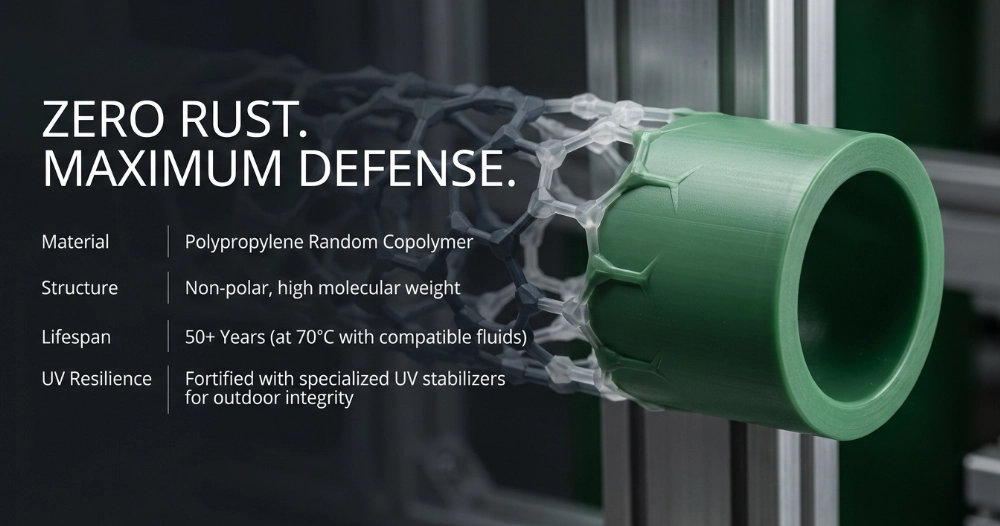
A common question is: Does PPR pipe rust? No. PPR is a plastic, so it does not rust or corrode like metal. This makes a chemical-resistant PPR pipe for water a strong choice where metal lines degrade fast.
How Compatibility Influences Service Life
Compatible fluids let PPR reach its full service life of 50+ years at 70°C. Incompatible chemicals attack the polymer, causing cracking, swelling, or embrittlement over time.
Why Safety Depends On The Right Match
Pipe failure near aggressive fluids creates leaks, spills, and exposure risks. The right pairing keeps workers safe and operations running without surprise shutdowns.
What Gives PPR Pipes Their Chemical Resistance?
The answer lies in the structure of the material itself. PPR resists many chemicals because of how its molecules are built.
How The PPR Pipe Material Resists Attack
The PPR pipe material is polypropylene random copolymer. Its non-polar structure and high molecular weight resist inorganic acids, alkalis, detergents, mineral oils, and seawater across a wide pH range.
Does PPR Handle Outdoor Exposure?
Raw polypropylene weakens under sunlight. To address this, manufacturers add UV stabilizers. Good ppr pipe UV resistance comes from these additives, which protect outdoor and irrigation lines from cracking.
Which Advantages Of PPR Pipes Support Fluid Transport
Several advantages of PPR pipes help here. Smooth inner walls reduce buildup. The material handles heat well, resists scale, and stays leak-free when fusion-welded.
Which Fluids Are Compatible With PPR Pipes?
PPR works with a broad list of common fluids. Below is a practical reference based on standard compatibility data.
Compatibility Reference Table
| Fluid | Compatibility | Notes |
| Distilled, soft, and hard water | Excellent | Stable to 100°C |
| Sodium chloride, seawater | Excellent | No corrosion |
| Calcium chloride (50%) | Excellent | Stable at 20–60°C |
| Sodium hydroxide (caustic) | Excellent | Strong base, well tolerated |
| Weak acids (citric, acetic 20%) | Good | Pair with PTFE-sealed valves |
| Sulfuric acid (10–75%) | Good | Watch temperature limits |
| Hydrogen peroxide (30%) | Fair | Drops sharply with heat |
Why PPR Suits Water Supply Systems
For potable lines, PPR pipe for water supply offers leak-proof joints and clean inner surfaces. It carries hot and cold water without affecting taste or releasing rust.
How Valve Pairing Improves Weak Acid Systems
When transporting weak acids, the pipe alone is not enough. Pair PPR with a DESO PPR ball valve fitted with a PTFE sealing ring. PTFE handles mild chemical attack and keeps the seal tight under repeated cycling.

Which Chemicals Can Affect PPR Pipes?
Not every fluid is safe. Some chemicals degrade PPR quickly, especially at higher temperatures.
Why Strong Oxidizers Cause Problems
Strong oxidizers break polymer chains. Chlorine gas, fuming nitric acid, and chromic acid all rate as severe. Avoid PPR for these fluids entirely.
Which Solvents Reduce PPR Strength
Certain solvents cause swelling and softening. Chlorinated solvents, ketones, and carbon disulfide weaken the wall and shorten service life.
How Aromatic Hydrocarbons React With PPR
Aromatic hydrocarbons such as benzene, toluene, and xylene absorb into the material. They soften the pipe and reduce the pressure rating, so they are not recommended.
When To Specify A Lined Valve Instead
For harsher process fluids near PPR’s limit, upgrade the control point. A bronze or stainless-steel lined valve handles severity that a standard PPR valve cannot. Match valve severity to fluid severity, not just the pipe.
Where Are PPR Chemical Piping Systems Used In Industry?
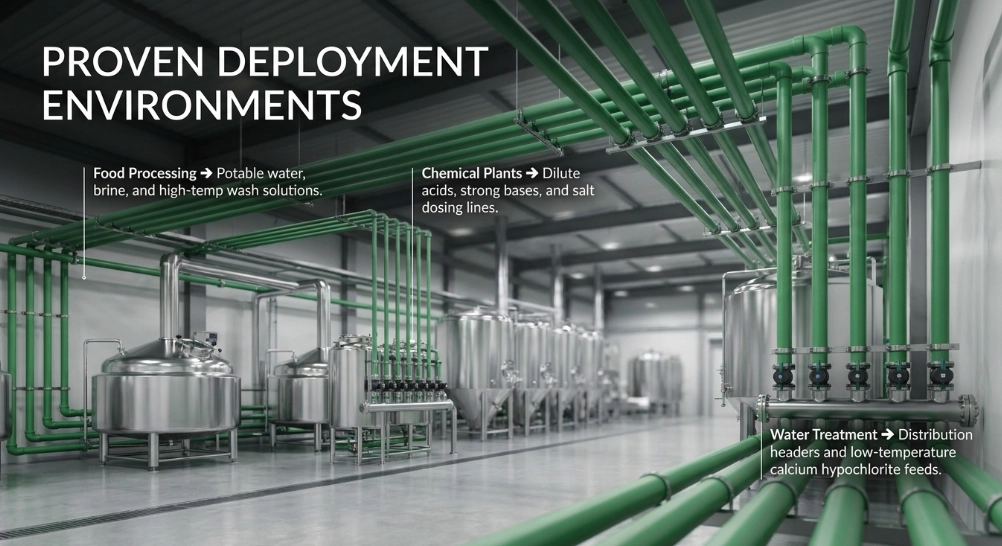
PPR serves many sectors that move water and mild chemicals daily. Its corrosion resistance fits demanding settings well.
- Food Processing Plants
Food plants need clean, taste-neutral lines. PPR carries potable water, brine, and wash solutions without corroding or harboring bacteria.
- Chemical Plants
Chemical sites use PPR for dilute acids, bases, and salt solutions.
Case example: a plant moving 20% acetic acid switched from corroding steel to PPR with PTFE-sealed ball valves and cut leak repairs sharply.
- Water Treatment Facilities
Treatment plants run dosing lines, transfer lines, and distribution headers.
Case example: a municipal site used PPR for a calcium hypochlorite feed at low temperature, then paired it with a lined valve at the injection point for added protection.
How Should You Verify Chemical Compatibility Before Installation?
Always confirm compatibility before you commit. Three factors decide success: the fluid, its concentration, and its temperature.
Check the exact chemical, its concentration, and the operating temperature together. A fluid rated safe at 20°C may rate poorly at 100°C.
Charts are a guide, not a guarantee. Run a sample test under real conditions before permanent installation. Validate joints with a proper PPR Pipe Pressure Testing Procedure Using Test Plugs: Step-by-Step Guide.
Pipe selection is only part of the job. For full layout and sizing, follow Designing a Commercial PPR Pipe System: The Ultimate Engineering Guide. For complex branches, review Y-Type Tee vs Equal Tee vs 5-Way Tee: Which PPR Fitting for Complex Branching?.
What DESO PPR Solutions Fit Industrial Fluid Systems?
DESO Pipe has manufactured PPR pipes and fittings since 2004, offering nearly 20 years of industrial experience. Our 30,000 m² factory runs over 200 automated machines and more than 50 testing devices. This results in an annual production of over 10,000 tons of high-quality piping materials.
Holding over 60 patents, DESO consistently meets CE, AENOR, DVGW, WRAS, and ISO standards. We produce pipes in sizes from DN20 to DN200, with both OEM and ODM options available. Our PP-R CT line offers 25% higher pressure resistance and includes a 50-year warranty.
For optimal performance, pair a chemical-resistant PPR pipe with a suitable valve from our collection. PTFE-sealed ball valves are ideal for weak acids, while lined valves handle more demanding applications.
To specify your system, you can explore our product collection and request the DESO catalog.

Frequently Asked Questions
Does PPR Pipe Rust Or Corrode?
No. PPR is a plastic, so it cannot rust. It resists chemical and electrochemical corrosion, which makes it suitable for water and many mild chemical lines.
Can PPR Pipe Carry Acids?
PPR handles many weak and dilute acids well. Strong oxidizing acids like fuming nitric or chromic acid are not recommended. Always check concentration and temperature first.
Is PPR Safe For Drinking Water?
Yes. PPR is taste-neutral, leak-proof, and corrosion-free. It carries hot and cold potable water without releasing rust or harmful particles into the supply.
How Does Temperature Affect Compatibility?
Higher temperatures lower chemical resistance. A fluid rated safe at 20°C may attack PPR at 100°C. Confirm ratings at your actual operating temperature.
Which Valve Should Pair With PPR For Chemicals?
Use a PPR ball valve with a PTFE sealing ring for weak acids. For harsher fluids, choose a bronze or stainless-steel lined valve.


