


Sunlight might not look dangerous, but over time, it can be one of the fastest ways to wear out plastic pipes. UV rays break down the material, causing fading, cracking, and a loss of strength, especially in pipes installed outdoors.
The good news is, with the right design, materials, and protective layers, you can keep your systems performing for years under the sun.
If your pipes live outdoors, uv protection pipe insulation is your first line of defense. DESO builds UV protection into its piping solutions so you don’t have to fight against the elements alone.
Why UV Protection Matters for Plastic Piping
Ultraviolet (UV) radiation from sunlight breaks down the molecular structure of most plastics over time, a process called photodegradation. This leads to discoloration, surface cracking, and reduced mechanical strength.
In piping systems, this can cause leaks or complete failures far earlier than the material’s intended lifespan.
The risk is especially high for pipes installed on rooftops, along exterior walls, or in open industrial spaces where they are exposed to direct sunlight for long hours each day. In hot, sunny climates, unprotected plastic can lose up to half of its impact strength in just a few years.
That’s why UV protection isn’t just an add-on—it’s a critical feature for any plastic pipe expected to operate outdoors.
Multi-Layer Composite Pipes for Built-In UV Resistance
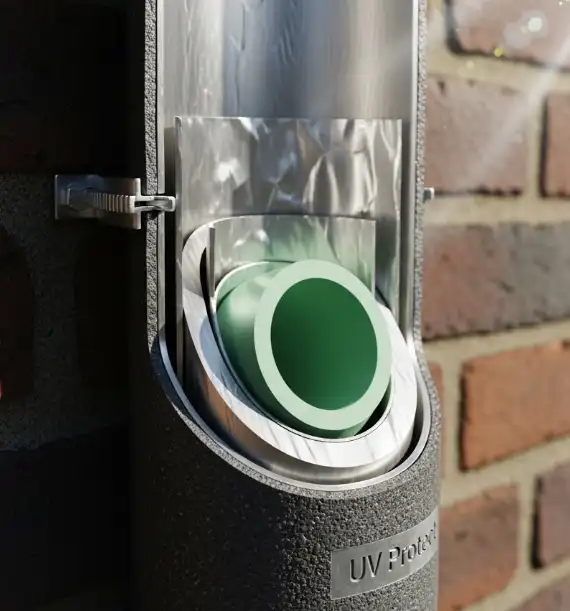
One of the most effective ways to shield plastic pipes from UV damage is to build the protection into the pipe itself. PPR Multi-layer construction works because the UV-resistant outer layer absorbs or reflects radiation, while the inner layers focus on strength, pressure resistance, and water quality. This approach is similar to how UV-protected greenhouse films or outdoor cables are designed—combining functional layers for long-term stability.
In real-world outdoor installations, this layered barrier significantly slows down the rate of surface degradation, keeping pipes strong, color-stable, and safe to operate for years beyond unprotected options.
Custom UV Protection for Different Climates
UV intensity varies widely by altitude and location, meaning a pipe on a mountain roof packs a different lifespan risk than one at sea level.
According to the WHO, UV levels increase with altitude because thinner air lets more rays through. Several authoritative sources agree: UV exposure climbs about 10–12% for every 1,000 meters above sea level.
DESO matches UV protection to local conditions by offering specialized UV coatings or custom multilayer structures. In scenarios with higher sun load—like tropical, desert, or high-altitude environments—this tailored approach helps maintain a pipe’s mechanical strength, color stability, and service life.
Quality Materials with Natural UV Resistance
Even before adding coatings or multilayer structures, the base material plays a big role in how well a pipe resists sunlight. Certain polypropylene grades and additives can significantly improve UV stability, slowing down oxidation and embrittlement.
DESO sources raw materials from Hyosung (Korea) and Borealis (Europe)—both known for producing polymers with enhanced light stability and weather resistance. These resins are engineered with UV stabilizers and antioxidants built into the polymer chain, so protection isn’t just skin-deep.
When combined with DESO’s extrusion control and optional UV-protective layers, these high-grade materials help ensure the pipes can handle years of outdoor exposure without significant loss in strength or performance.

Tips for Extending Pipe Life Outdoors
Even with UV-resistant materials, how you install and maintain the system can make a big difference in longevity. A few proven practices include:
- Add insulation or cladding – Using UV-protective pipe insulation reduces direct exposure and helps maintain surface temperature.
- Position pipes thoughtfully – Where possible, run pipes along shaded walls or under eaves to limit peak sunlight hours.
- Combine coatings with insulation – This creates a double barrier against both UV and heat damage.
- Inspect periodically – Look for early signs of chalking, color fade, or surface cracks. Addressing them early can prevent structural issues.
These measures work especially well when paired with DESO’s UV-protected composite pipes, maximizing service life even in the harshest sunlight.
UV Protection Pipe Insulation: Final Word
If your next project needs UV protection pipe insulation or built-in UV resistance that matches your climate and installation environment, talk to us today. We’ll help you choose the right DESO piping solution to keep your system performing under the sun for years to come.


