


When it comes to plumbing and heating systems, durability and safety matter most. So, how is PPR pipe manufactured? In short, PPR pipes are made through a precise, high-quality process using polypropylene random copolymer (PP-R). This process creates pipes that are strong, corrosion-resistant, and safe for hot and cold water systems, making them a trusted choice worldwide.
Below, we’ll break down every step of PPR manufacturing, explain what PPR pipes are made of, and share why DESO Pipe stands out among PPR pipe manufacturing companies.
Why Global Top 10 PPR Pipe Brands Choose DESO?
| Key Factors | DESO | Others |
|---|---|---|
| International Certifications (ISO, WRAS, CE) | ✅ Full Set | ⚠️ Partial or None |
| Premium Raw Materials | ✅ Borealis & Hyosung | ❌ Recycled / Low-grade |
| Guaranteed Delivery Time | ✅ 100% On-Time in 5 Years | ❌ Uncertain |
| OEM Support: Branding & Packaging | ✅ Color, Logo, Manuals in 7 Days | ❌ Weak or None |
| Technical Match & Mold Flexibility | ✅ 500+ Molds / Custom Options | ❌ Limited Compatibility |
What Is PPR Pipe Made Of?
PPR pipes are primarily made from polypropylene random copolymer (PP-R), a thermoplastic known for high durability, excellent chemical resistance, and thermal stability. At DESO Pipe, we use internationally recognized high-quality raw materials:
- Korean Hyosung (Topilene® R200P): Outstanding melting performance, strong stability, and excellent heat resistance. Perfect for high-standard hot melt systems, it is known for its long-term hydrostatic pressure resistance (MRS 12.5 MPa) and high heat deflection temperature of 90°C.
- German Borouge/Borealis materials: Known for high tensile strength and superb thermal stability, supporting long-term pressure resistance and ensuring smooth water flow in demanding systems.
All products are made from new materials only — no recycled materials are used, which ensures a long service life and reliable performance. In fact, even the recycled scraps within the production line are reused internally but never sourced externally, ensuring global consistency standards.
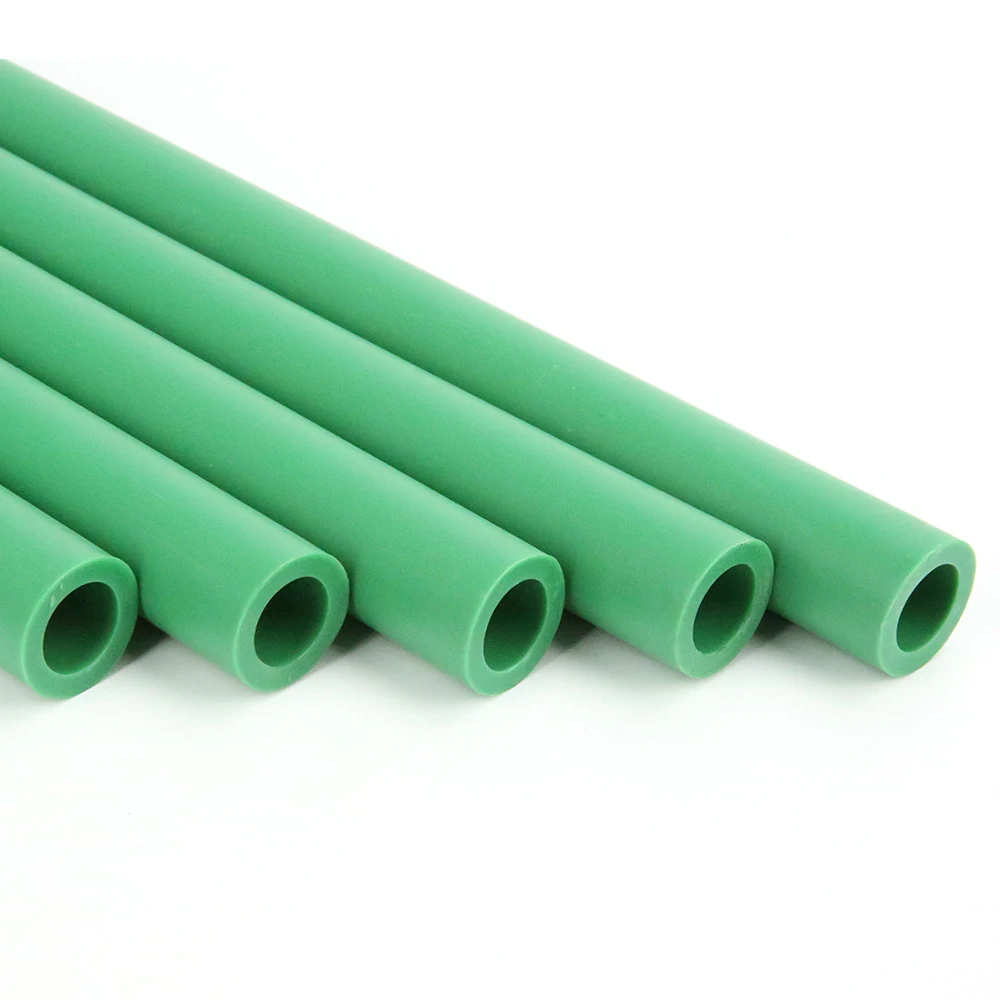
Overview of the PPR Pipe Production Process
1.Raw Material Preparation
First, the high-quality PP-R raw materials are carefully tested and prepared. Accurate measurement and mixing ensure a uniform base for extrusion, which is crucial for consistent pipe quality and performance.
2.Extrusion and Pipe Shaping
During extrusion, the PP-R compound is melted and pushed through a die to form the pipe shape. The melt temperature is typically between 200°C and 220°C. Precise control during this step ensures the pipe maintains exact dimensions and smooth interior surfaces, essential for smooth water flow and minimal pressure loss.
3.Cooling and Calibration
Immediately after extrusion, pipes enter a cooling system (usually water baths at 20–30°C) to stabilize their shape and prevent deformation. Calibration sleeves and vacuum systems keep the diameter accurate and uniform throughout.
4.Cutting and Marking
Pipes are cut into standard lengths and marked with essential details, including diameter, wall thickness, production batch, and compliance certifications. This step helps ensure traceability and consistent quality.
5.Final Inspection and Packaging
DESO Pipe maintains a comprehensive quality control system, incorporating internal inspections, laboratory testing, and third-party certifications to ensure the highest standards of quality. Every pipe undergoes strict checks for dimensional accuracy, pressure resistance, and visual quality before being carefully packaged for delivery.

Why Choose DESO Pipe Materials?
Below is a quick comparison table summarizing the key advantages of DESO’s main raw materials versus other common options in the global market.
| Feature | Korean Hyosung R200P | German Borouge/Borealis | Sabic 9460 (Saudi Arabia) | LyondellBasell Hostalen PP-R Type 3 |
| Melt Flow Rate | 0.25 g/10min (ASTM D1238) | 0.25–0.35 g/10min | ~0.25 g/10min | 0.25 g/10min |
| Vicat Softening Point | ≥130°C | 126–130°C | ~126°C | ~127°C |
| Tensile Strength | 270 kg/cm² | ~260–270 kg/cm² | ~250 kg/cm² | ~260 kg/cm² |
| Flexural Modulus | 9,000 kg/cm² | ~9,000 kg/cm² | ~8,000–9,000 kg/cm² | ~9,000 kg/cm² |
| Notched Izod Impact (23°C) | >10 N.B. (no break) | >8kJ/m² | ~8 kJ/m² | ~8 kJ/m² |
| Thermal Expansion Coefficient | 1.5 × 10⁻⁴ K⁻¹ | ~1.5 × 10⁻⁴ K⁻¹ | ~1.5 × 10⁻⁴ K⁻¹ | ~1.5 × 10⁻⁴ K⁻¹ |
| Long-Term Pressure Resistance (MRS) | 12.5 MPa | 12.5 MPa | 12.5 MPa | 12.5 MPa |
| Certifications & Compliance | NSF, DVGW, DIN, ISO, FDA, EU 10/2011 | International Standards | ISO, DIN, WRAS, ACS | ISO, DIN, WRAS |
Using these materials ensures PPR pipes that are corrosion-resistant, have low thermal conductivity, and maintain food-grade safety, making them ideal for hot and cold water systems, HVAC, and industrial fluid conveyance.
Benefits of Modern PPR Pipe Manufacturing

Modern PPR pipe manufacturing delivers numerous benefits:
- Long service life: Over 50 years of reliable use with minimal maintenance.
- Excellent chemical resistance: Handles harsh fluids without corrosion.
- Smooth interior surface: Promotes smooth water flow and prevents scaling.
- Recyclable pipes: Support sustainable, environmentally friendly systems.
- Food-grade safety: Non-toxic and safe for potable water.
These qualities make PPR pipes ideal for a wide range of applications — from residential plumbing to large-scale industrial projects.

Final Thoughts
Understanding how PPR pipes are manufactured gives you confidence in the products you specify or install. From raw materials to final packaging, every step matters. DESO Pipe uses only internationally recognized materials (Hyosung and Borealis), advanced automation, and strict testing to ensure each pipe delivers long service life, reliable flow, and certified performance.
Ready to build with confidence? Explore DESO’s full range of PPR pipes and fittings manufactured to global standards. Visit our factory page to learn more.


