


Respuesta rápida
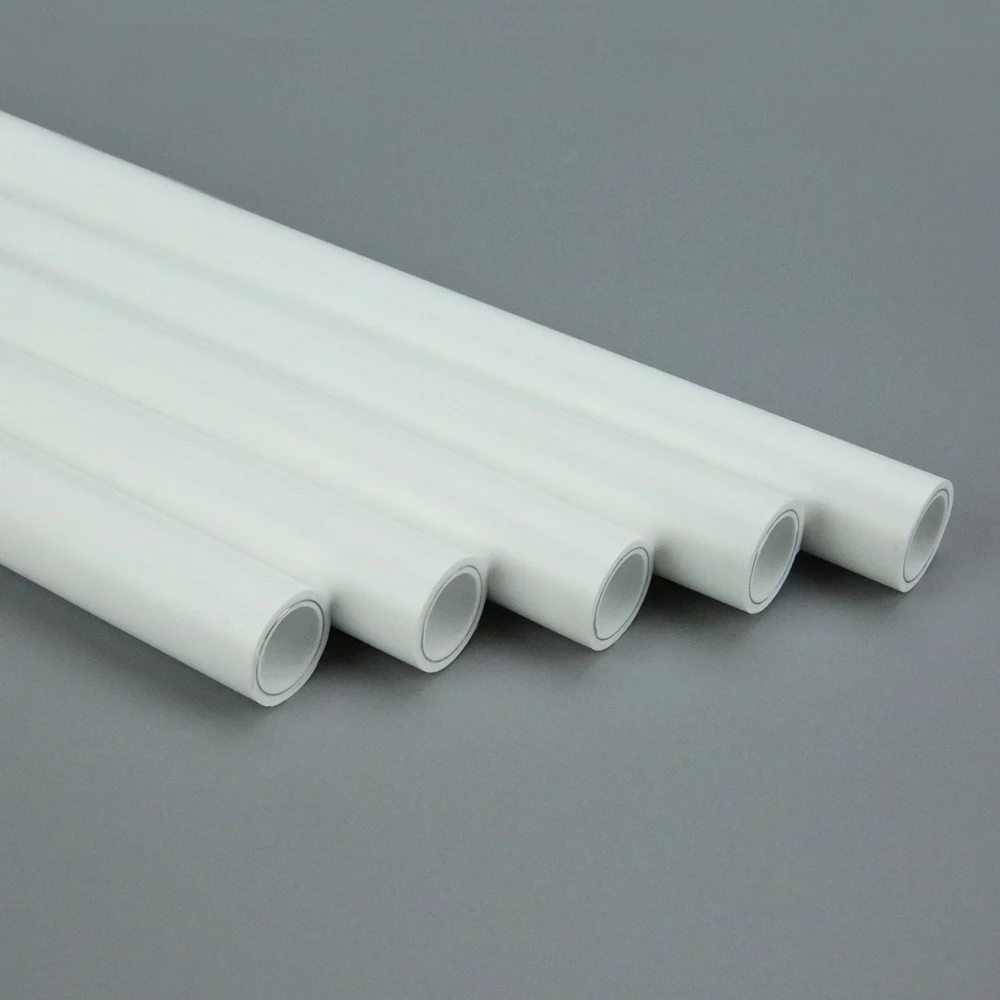
The PPR aluminum composite pipe aluminum layer limits oxygen diffusion, reduces thermal expansion, and improves dimensional stability. These properties are useful in hot-water and closed-loop heating systems. DESO combines PPR and aluminum in a three-layer pipe available in PN16 and PN20.

How Does the Aluminum Layer Act as an Oxygen Barrier?
Oxygen is prevented from diffusing through the pipe wall when a continuous aluminum layer is part of the installation.
Rather than stopping the PPR from corroding, the barrier is there to limit oxygen ingress and help safeguard ferrous components present elsewhere in the system. These may include heat exchangers, pumps, boilers, and steel radiators, with the PPR already resisting electrochemical corrosion.
How Does the Aluminum Layer Reduce Thermal Expansion?
PPR estándar expands and contracts with shifts in water temperature. Some of this movement can be restricted by adding a continuous aluminum layer, as aluminum tends to expand much less than unreinforced PPR.
The difference can be bigger than you’d expect. DESO’s Climatización guidance gives a linear expansion coefficient of about 0.150 mm/m·K for standard PP-R and 0.050 mm/m·K for PPR-AL-PPR. To compare, the composite construction has about one-third of the thermal expansion of standard PP-R.
Less movement helps long hot-water runs stay aligned and reduces the amount of expansion the piping layout has to accommodate. Supports and expansion planning are still necessary. The aluminum layer does not make thermal movement disappear.
How Does the Aluminum Layer Improve Rigidity and Dimensional Stability?
The aluminum layer also acts as a reinforcing framework inside the pipe wall. It makes the pipe more rigid and helps it maintain its shape as temperatures change.
That does not mean aluminum alone determines the pipe’s allowable pressure. Pressure performance depends on the complete construction, including wall dimensions, PPR material, temperature, and operating conditions.
DESO’s PPR aluminum composite pipe uses a three-layer PPR-aluminum-PPR design and is available in PN16 and PN20. Its published size range runs from 20 to 63 mm.
Aluminum vs. Fiber-Reinforced PPR: Which Fits Your Project?
Both aluminum and fiber reinforcement can improve dimensional stability, but they do not perform exactly the same function.
DESO fiber composite pipe uses 20% glass-fiber reinforcement and is available from 20 to 160 mm across PN10 to PN20. It can be useful when the main goal is reducing temperature-related movement while retaining an all-polymer composite construction.
Aluminum adds something fiber reinforcement does not: a continuous barrier against oxygen diffusion through the pipe wall. That can make PPR pipe with aluminum particularly relevant for closed hydronic systems with oxygen-sensitive components.
Unlike a broad PPR pipe vs PVC comparison, choosing between these reinforced PPR types comes down to what the reinforcement needs to accomplish. Neither option is universally better.
How Does Aluminum Layer Thickness Affect Performance? Is 0.2 mm Enough?
Not necessarily. No universal rule states that a 0.2 mm aluminum layer is sufficient for all PPR aluminum composite pipes.
In fact, aluminum thickness is just a single aspect of a multilayer design. You must also account for layer arrangement, pipe diameter, manufacturing method, bonding quality, and required performance. Although a PPR pipe standard may set dimensions or performance requirements, it doesn’t mean that every standard requires the same aluminum thickness.
DESO publishes the dimensions and pressure classes of its aluminum composite pipe range but does not publicly specify a separate aluminum-foil thickness on its product page. It would therefore be misleading to assign a 0.2 mm requirement to DESO’s range.
A thicker aluminum layer does not automatically mean a better product either. Aluminum thickness alone does not determine PPR pipe lifespan. The complete construction, operating conditions, bonding quality, and installation all affect long-term performance.
What Should You Remember About the Aluminum Layer?
Three useful jobs performed by the aluminum layer:
- It restrains thermal expansion
- It limits oxygen diffusion
- It increases dimensional stability
Due to these benefits, aluminum-reinforced PPR comes in handy when PPR pipe plumbing requires additional expansion control or when an barrera de oxígeno is required by a closed-loop system. Just remember the right construction depends on the job that the reinforcement needs to perform.
Preguntas frecuentes
1. What is the purpose of the aluminum layer in PPR aluminum composite pipe?
It limits oxygen diffusion through the pipe wall, reduces thermal expansion, and increases rigidity and dimensional stability.
2. How does the aluminum layer prevent oxygen permeation?
A physical barrier is created by the continuous metal layer to prevent oxygen from diffusing through the pipe wall. Oxygen-barrier performance is expressed in terms of allowable permeability rather than the whole piping system being treated as impermeable.
3. What is the difference between PPR-AL-PPR and standard PPR pipe?
PPR-AL-PPR adds an aluminum layer between PPR layers. Due to this reinforcement, thermal expansion is reduced and you gain an oxygen barrier along with improved dimensional stability.
4. How thick is the aluminum layer in PPR composite pipe?
No single thickness applies to every product or diameter. Instead, the complete pipe design determines the required thickness, with specifications potentially varying between manufacturers.
5. Does the aluminum layer affect pipe flexibility?
Yes. Adding aluminum makes the pipe more rigid than an equivalent unreinforced plastic construction, which is part of how it limits temperature-related movement.


